Discipline & Duty
🎯 Topic Pillar Hub 📚 34 Illustrated Stories

Discipline & Duty

Self-discipline and duty are the bedrock of character, transforming sincere effort into lifelong achievement and inner strength.

✕ Clear
All Stories Friendship Discipline & Duty Courage Honesty Kindness Patience & Humility Digital Ethics Environment Civic Duty & Safety Wisdom Fairness & Inclusion Compassion
The Shortcut Through the Garden

The Shortcut Through the Garden

Students cut across a garden to save a minute and damage young plants. Instead of blaming one another, they accept the impact, choose a better route, and help restore the garden.

The Practice Nobody Saw

The Practice Nobody Saw

A student prepares for a school music performance through short, regular practice sessions. Progress comes gradually, reminding them that unseen effort matters more than a sudden display.

The Champion Who Came Second

The Champion Who Came Second

After years of training, a young runner finishes second. They congratulate the winner and choose a specific skill to improve, learning that rank matters in a race but does not define a person’s worth.

The Promise to Tomorrow

The Promise to Tomorrow

A class plans a celebration with limited time and supplies. By considering what younger students will need after the event, they create a realistic plan that balances present enjoyment with future responsibility.

The Bamboo in the Wind

The Bamboo in the Wind

A storm damages a rigid garden frame but leaves flexible bamboo supports standing. A gardener learns to combine strength with adaptability and rebuilds a sturdier structure.

The Bridge Keeper’s Question

The Bridge Keeper’s Question

A bridge needs repairs while residents still depend on it. The keeper asks who will be affected, identifies risks and alternatives, and helps the community agree on a clear, safer schedule.

The Promise Made in the Rain

The Promise Made in the Rain

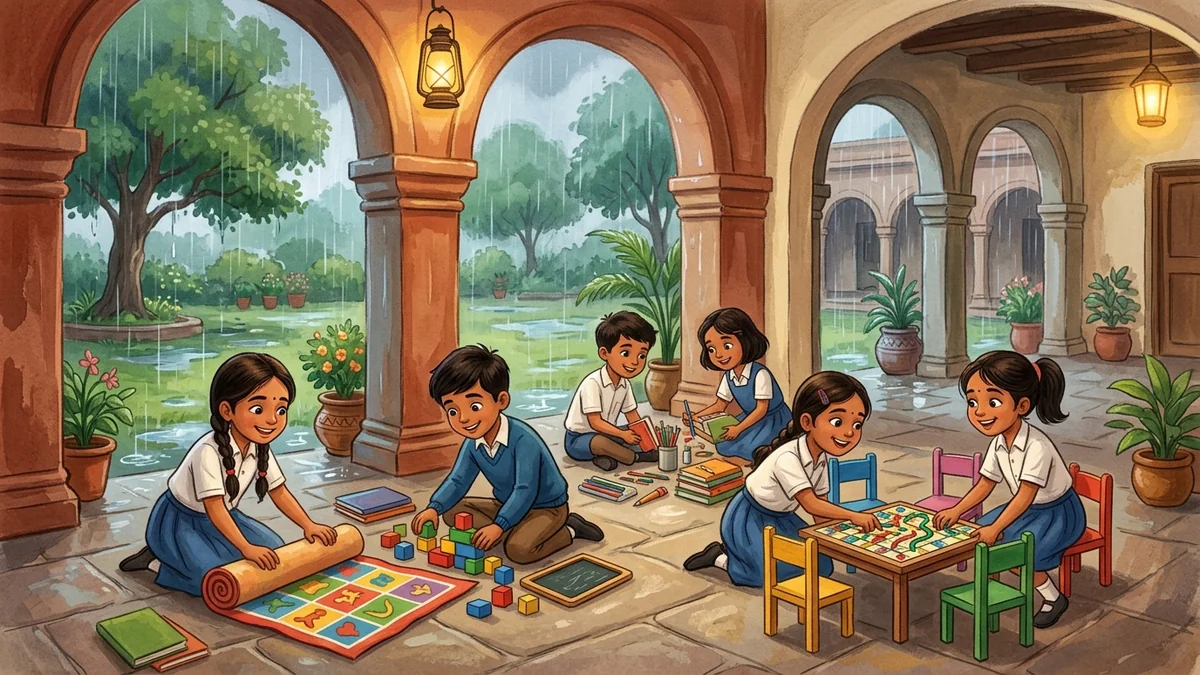
Two friends promise to hold an outdoor reading afternoon, but heavy rain changes their plans. They communicate early, find a safer indoor option, and keep the promise in a realistic way.

The Night the Lights Went Out

The Night the Lights Went Out

When a storm cuts power, neighbours check on one another, use safe light sources, and share reliable updates instead of spreading rumours.

The Letter to a Future Child

The Letter to a Future Child

A class writes letters describing what they hope future children will inherit: clean spaces, useful knowledge, welcoming communities, and the freedom to improve what remains.

The Umbrella with the Blue Handle

The Umbrella with the Blue Handle

A child borrows an umbrella from a neighbour, then forgets it on a bus. The child tells the neighbour honestly and helps arrange a replacement.

The Honest Woodcutter

The Honest Woodcutter

Gangadhar, a destitute yet deeply virtuous woodcutter, sustained his impoverished family by collecting deadwood along the riverbank. One afternoon, while chopping a withered branch overhanging the rushing waters, his sole iron axe slipped from his sweat-slicked fingers and plunged into the river's unfathomable depths. Deprived of his only means of livelihood, the honest man wept in despair. Moved by his grief, the River Deity materialized from the waters. The divine being first drew forth a gleaming axe of solid gold, which Gangadhar immediately disowned as not his. Next, a magnificent silver axe was offered, which he also gently declined. Finally, when his own modest, rusted iron axe was retrieved, Gangadhar cried out in joyous gratitude. Deeply moved by such incorruptible integrity, the deity bestowed all three axes upon him. The classic fable affirms that unyielding honesty brings rewards far surpassing dishonest gain.

The Thirsty Crow

The Thirsty Crow

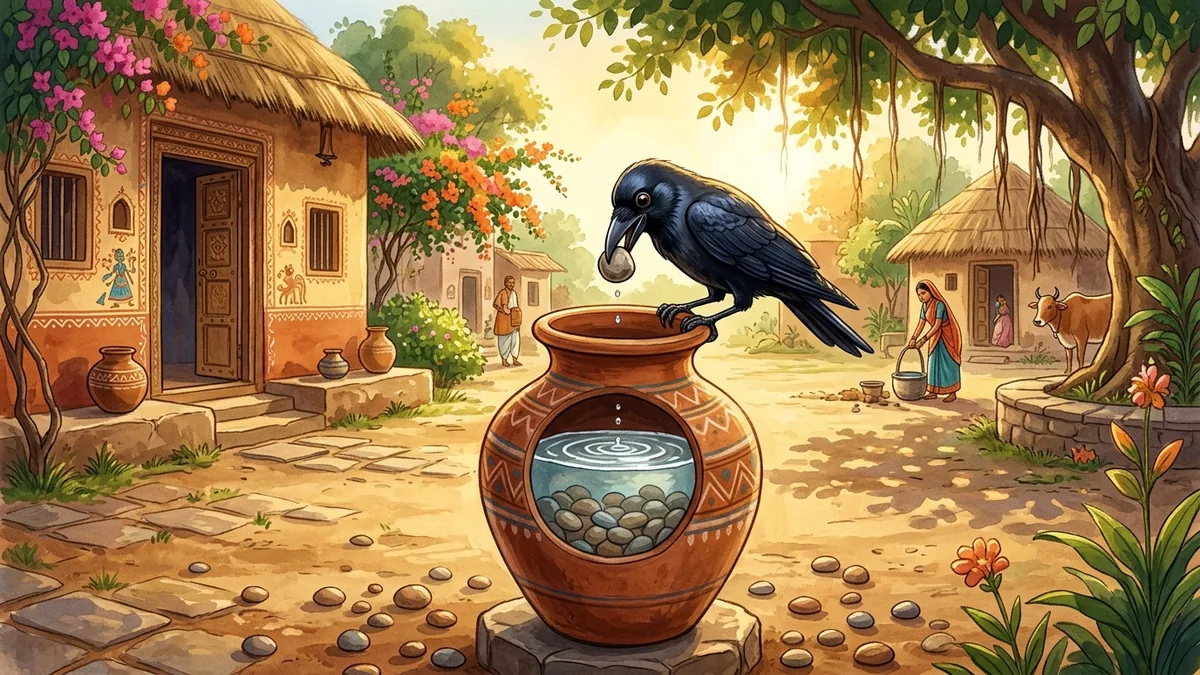
During a devastating summer drought when forest streams and village ponds dried to parched dust, Meghavarna, an observant crow, was on the verge of collapsing from dehydration. After hours of scouring the scorched plains, he discovered an earthen pitcher in an abandoned orchard. At the very bottom lay a small reserve of cool water; however, the pitcher’s narrow neck prevented his beak from reaching the surface. Pushing or overturning the heavy vessel proved impossible. Refusing to yield to despair, Meghavarna observed the gravel scattered across the garden path and devised an ingenious method. With tireless patience, he picked up smooth pebbles one by one and dropped them into the vessel. As the stones displaced the water, the liquid gradually rose to the brim until he drank his fill. The timeless fable proves that patience, observation, and methodical ingenuity overcome obstacles that sheer physical force cannot budge.

The Hare and the Tortoise

The Hare and the Tortoise

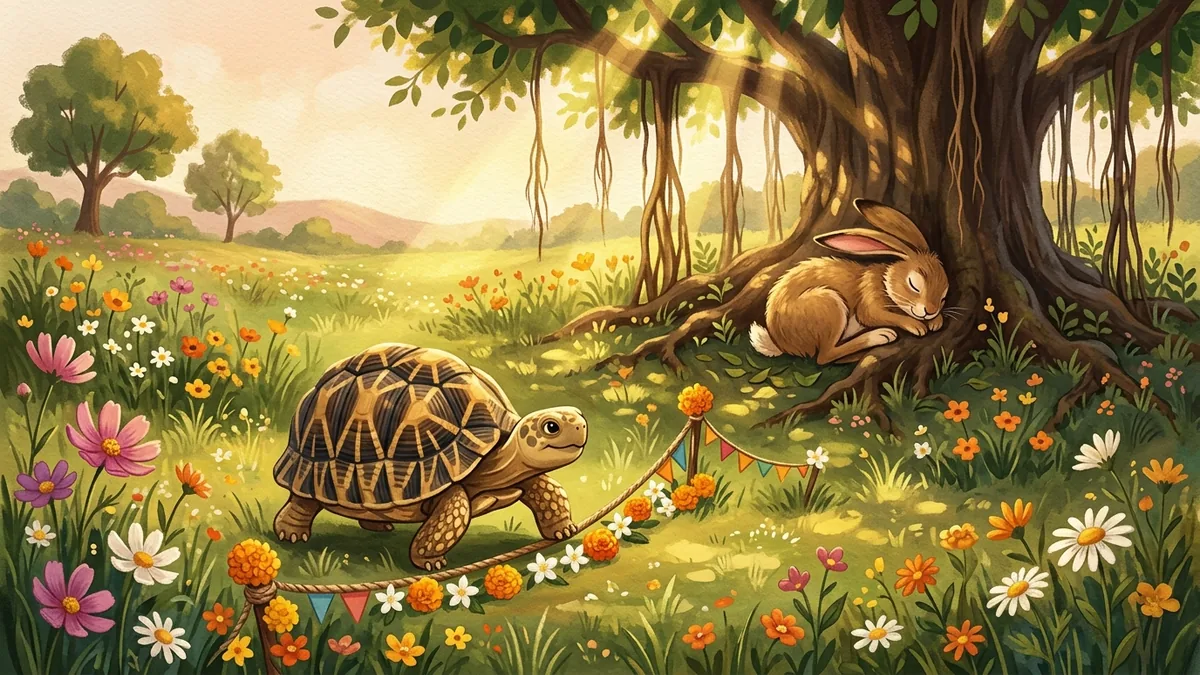
In the foothills of Mount Mandara lived Chapala, an exceptionally swift hare whose arrogance matched his speed. He relentlessly mocked Mantharaka, an elderly tortoise who moved with deliberate, plodding steps. Weary of the constant ridicule, the tortoise challenged the boastful hare to a long-distance race to the mountain ridge. Roaring with derisive laughter, Chapala accepted. As the race commenced, the hare bolted ahead like an arrow, vanishing over the hill. Looking back and seeing no sign of his opponent, Chapala grew dangerously overconfident and lounged beneath a shady banyan tree, slipping into deep slumber. Meanwhile, Mantharaka plodded forward with unswerving discipline, never pausing, never despairing. By the time the hare awoke in the setting sun, the tortoise had crossed the finish line to the cheers of the woodland realm. The immortal fable demonstrates that consistent, disciplined persistence triumphs over sporadic talent ruined by complacency.

The Boy Who Cried Wolf

The Boy Who Cried Wolf

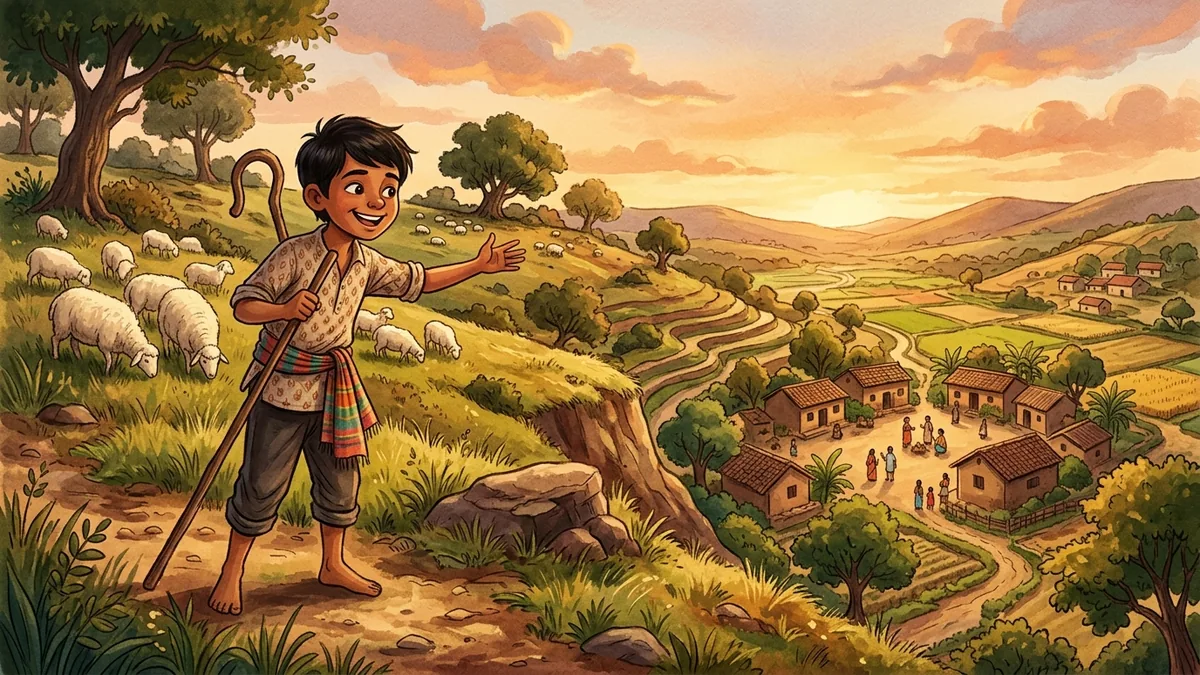
Hariya, an impulsive and restless shepherd boy, tended village sheep upon the mist-veiled mountain slopes. Bored by the quiet monotony of his chores, he concocted a reckless amusement to startle the nearby hamlet. Scrambling atop a high crag, he screamed with theatrical terror: 'Wolf! Wolf! Help me, the flock is under attack!' Alarmed villagers dropped their scythes and ran uphill armed with cudgels to defend him, only to find the boy rolling in laughter at their expense. Weeks later, he repeated the callous deception. But one stormy twilight, a genuinely ferocious grey wolf emerged from the ravines. Hariya shrieked in mortal dread, but the weary villagers assumed it was another cruel prank and ignored his cries. The predator mauled the flock, leaving Hariya shivering in despair. The immortal fable warns that habitual deceit shatters trust, ensuring that a liar is disbelieved even when uttering absolute truth.

The Lion and the Mouse

The Lion and the Mouse

A mighty lion slept peacefully in the shade of a dense forest canopy after a heavy feast. An inquisitive field mouse, foraging for wild berries, accidentally scurried onto the sleeping beast's massive paws and scrambled through his thick mane. Awakened and infuriated, the monarch pinned the tiny rodent beneath his lethal claws, preparing to crush it. Trembling, the mouse begged for mercy, promising that even the humblest creature might one day return the royal kindness. Amused by the absurdity of a tiny mouse aiding the lord of beasts, the lion chuckled and magnanimously released him. Months later, the lion stepped into an iron-bound rope snare set by big-game hunters. Bound hand and foot, his thunderous roars of anguish shook the jungle. Recognizing the voice of his benefactor, the mouse rushed to the trap and gnawed through the heavy cords with razor-sharp teeth, setting the emperor of beasts free. The classic fable teaches that no act of kindness is ever wasted and that greatness must never despise the humble.

The Ant and the Grasshopper

The Ant and the Grasshopper

During the lush, sun-drenched months of spring and summer, a dedicated worker ant laboured from dawn to dusk, carrying heavy grains into her deep subterranean storehouse to prepare for the inevitable winter. On an adjacent thistle rested an indolent grasshopper who spent entire days strumming his mandolin, basking in the sun, and mocking the ant's ceaseless exertion. The grasshopper preached that life was meant for carefree leisure and that worrying about distant seasons was sheer folly. Ignoring his scoffing, the ant remained faithful to her toil. When winter descended, blankets of frost and blizzard buried the earth, cutting off every trace of forage. Shivering violently and starving, the grasshopper crawled to the ant's warm threshold begging for food. The ant reminded him that those who squander bountiful summers in reckless frivolity must face the harsh reality of winter. The timeless parable teaches that foresight and diligent industry guarantee survival, while procrastination invites inevitable catastrophe.

The Greedy Dog

The Greedy Dog

Kalu, a stray dog hardened by city alleys, scavenged relentlessly for daily scraps. One fortunate morning, he snatched a succulent, marrow-filled bone outside a butcher's stall. Desiring to relish his prize in undisturbed solitude, he trotted toward the forested outskirts. Along the path lay a narrow wooden footbridge spanning a crystal-clear mountain stream. Pausing mid-span, Kalu glanced down into the tranquil waters and beheld his own mirror reflection. Blinking through the prism of insatiable greed and ignorance, he mistook the image for a rival dog bearing an even larger, juicier bone. Coveting the phantom treasure, he snarled and barked aggressively to intimidate his reflection. The instant his jaws parted, his genuine bone plunged into the rushing torrent and was swept away forever. Starving and humiliated, Kalu was left to lament his folly. The fable proves that unchecked greed forfeits real blessings in pursuit of empty illusions.

The Fox and the Sour Grapes

The Fox and the Sour Grapes

On a scorching autumn afternoon, Lomasha, a proud and cunning fox, wandered through parched orchards starved and dehydrated. After hours of fruitless foraging, she discovered a prosperous farmer's walled vineyard. Hanging from high rustic trellises were magnificent clusters of plump, sun-ripened purple grapes glistening with sweet nectar. At the sight of this luscious fruit, the fox's mouth watered with intense craving. Backing up several paces, she launched herself into the air with all her athletic power, but her paws fell tantalizingly short. She leaped repeatedly until her joints ached and exhaustion overwhelmed her. Realizing that the prize lay entirely beyond her physical reach, she masked her humiliation with haughty disdain, turning up her snout and declaring: 'These grapes are undoubtedly sour and unripe; I would not poison my palate with such worthless trash.' The fable exposes the human tendency to disparage what one cannot attain, proving that true maturity lies in acknowledging limitations rather than slandering the goal.

The Two Friends and the Bear

The Two Friends and the Bear

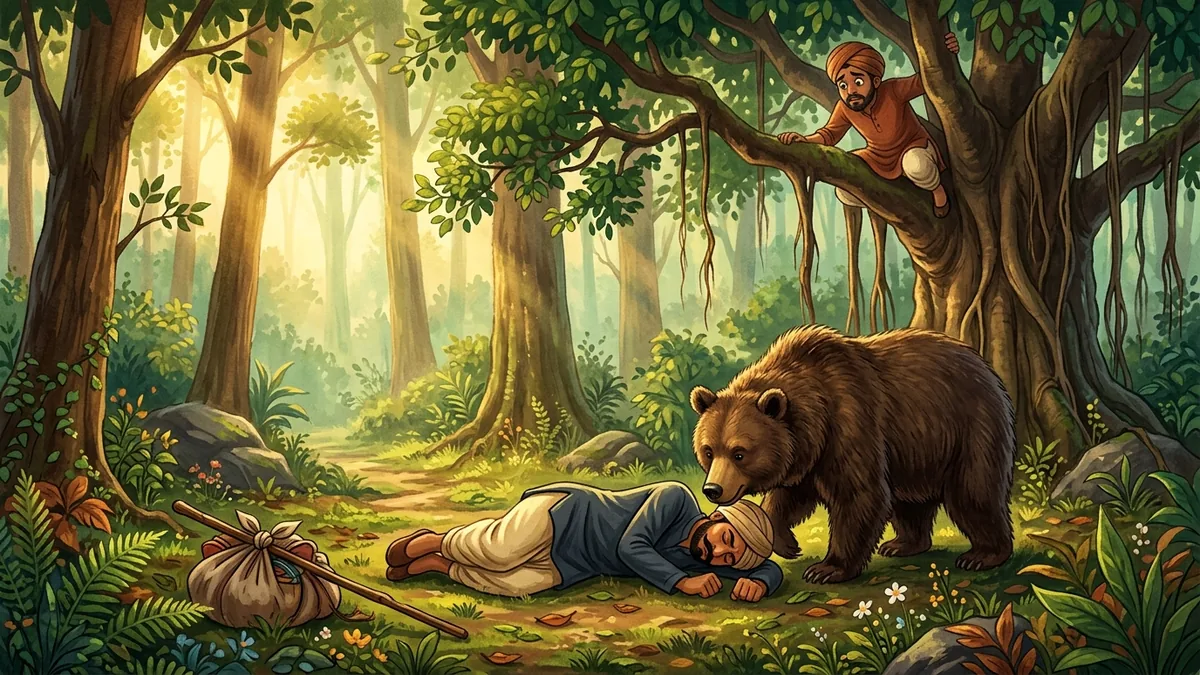
Rohan and Sohan, two lifelong companions, journeyed through an untamed forest to sell wares in a distant market town. Before entering the wild ravines, they solemnly pledged to stand shoulder-to-shoulder against any peril. In the heart of the woods, a monstrous Himalayan bear emerged from the brush, growling menacingly. Rohan, an agile climber, thought only of his own skin, sprinting to an ancient oak and pulling himself up into the canopy without extending a hand to his companion. Sohan, unable to climb, recalled an old lore that bears do not devour dead carrion. Dropping flat onto the moss, he sealed his breath, stiffening like a corpse. The massive beast sniffed his temples, ears, and chest; sensing no breath, it shuffled away into the thickets. When safety returned, Rohan slid down and asked jokingly, 'What did the bear whisper in your ear?' Dusting his tunic, Sohan replied calmly: 'The bear cautioned me never to travel with a friend who deserts you in the hour of peril.' The story demonstrates that adversity is the true crucible of friendship.

The Farmer and the Bundle of Sticks

The Farmer and the Bundle of Sticks

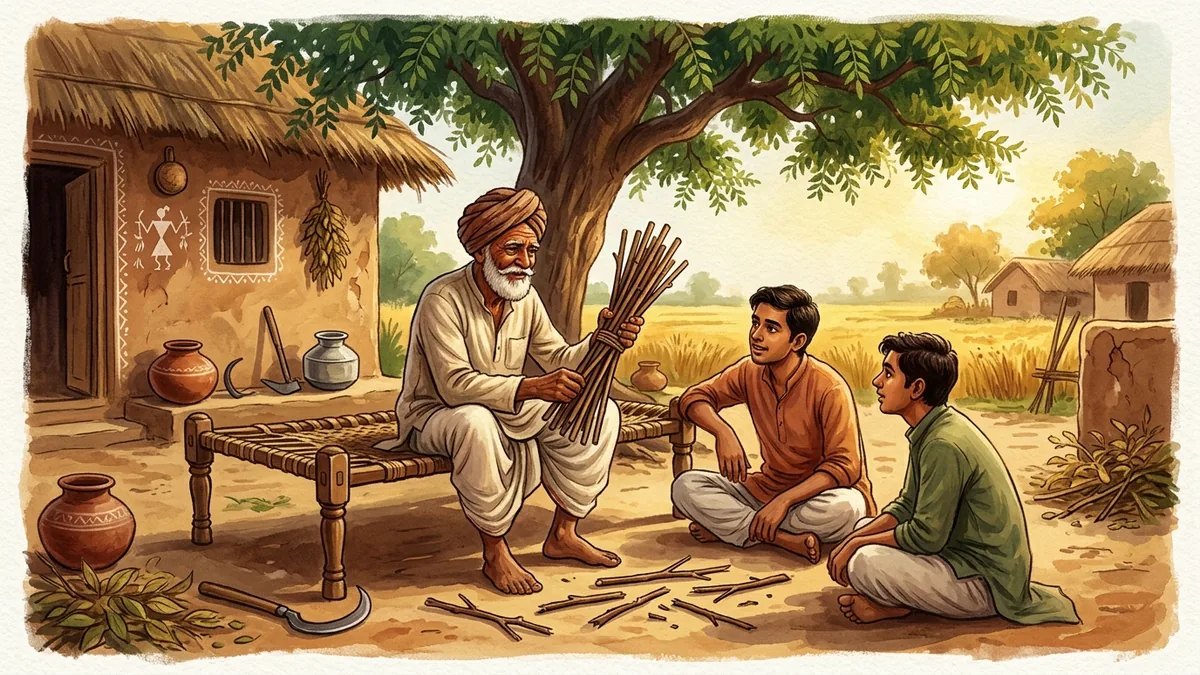
Dharmapala, an aging and respected patriarch of Kaushambi, had four robust, hardworking sons. Though blessed with health and fertile lands, the household knew no peace, for the brothers quarrelled endlessly over chores, status, and inheritance. Troubled on his deathbed that greedy rivals would exploit their bitter discord to plunder the ancestral farm, Dharmapala devised a practical object lesson. Summoning his sons, he ordered a bundle of twenty thick hazel staves bound tightly with rawhide cords. He commanded each son, in order of strength, to break the bundle across their knees. Despite straining every sinew, none could snap or bend the united bundle. The father then untied the cords and handed a single stave to each son, which they fractured effortlessly with a snap of their fingers. Dharmapala imparted the timeless moral: united like the bundle, no adversary can break you; divided into solitary sticks, the slightest blow will shatter your lives. The fable illustrates that familial and communal solidarity is an impregnable fortress.

The Goose That Laid Golden Eggs

The Goose That Laid Golden Eggs

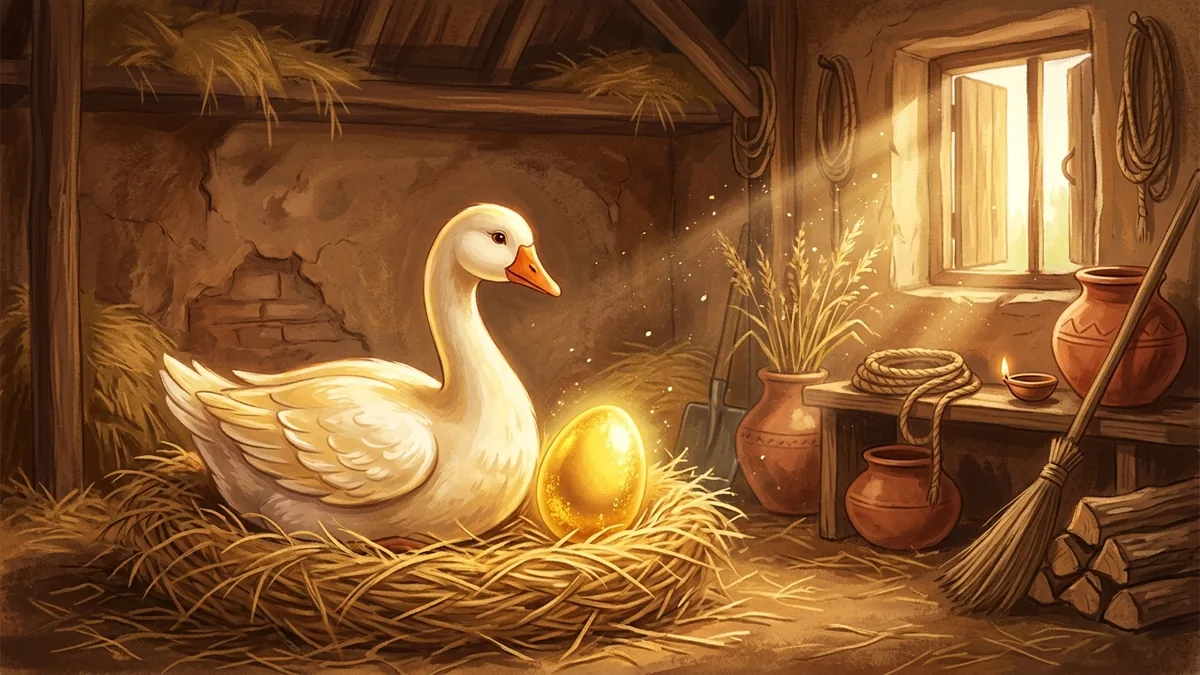
In a quiet valley of Manipur lived Devadatta, an impoverished tenant farmer, and his wife. One evening, he acquired an unassuming goose from a traveling poultry vendor. The following morning, his breath hitched in wonder: resting in the straw was a heavy, lustrous egg of solid, 24-karat gold. Faithfully, each dawn, the wondrous bird deposited a single golden egg in the nest. By selling this daily bounty to the royal goldsmith, Devadatta transformed his thatched hut into a grand manor, rising to immense affluence. Yet with fortune came the fatal infection of unbridled avarice and impatience. Whispering in his ear, his wife argued that if the bird produced golden eggs, its interior must house an inexhaustible mountain of molten gold. Why wait for daily crumbs when they could seize the entire fortune in one stroke? Blinded by rapacity, Devadatta took a butcher's cleaver and slaughtered the goose. To their horror, the bird's anatomy was identical to any ordinary fowl; not a grain of gold existed inside. Deprived forever of their daily miracle, they sank back into penniless obscurity. The fable illustrates that insatiable greed and haste destroy the very wellspring of enduring prosperity.

The Dove and the Ant

The Dove and the Ant

Upon a lush jambul tree overhanging the sacred Narmada river nested a gentle, compassionate white dove. Beneath the ancient roots dwelled a tiny worker ant. One afternoon, while sipping water at the river's edge, a sudden swell swept the frail ant into the rushing current. Flapping helplessly toward certain drowning, her plight was spotted by the dove above. Stirred by pity, the bird plucked a broad leaf with her beak and dropped it directly beside the drowning insect. The ant scrambled onto the leaf and floated safely ashore. Days later, a cruel fowler stepped softly through the glade. Spotting the tranquil dove resting upon a branch, he notched a poisoned arrow and drew his bowstring to his ear. The dove was unaware of imminent death. Witnessing the peril, the grateful ant crawled up the hunter’s bare ankle and bit his heel with all her might. Howling in agony, the hunter jerked his bow, sending the arrow wide into the bushes. Alerted by the sound, the dove took flight, escaping harm. The fable shows that even the smallest act of kindness reverberates through destiny, returning as salvation in times of peril.

The Cap Seller and the Monkeys

The Cap Seller and the Monkeys

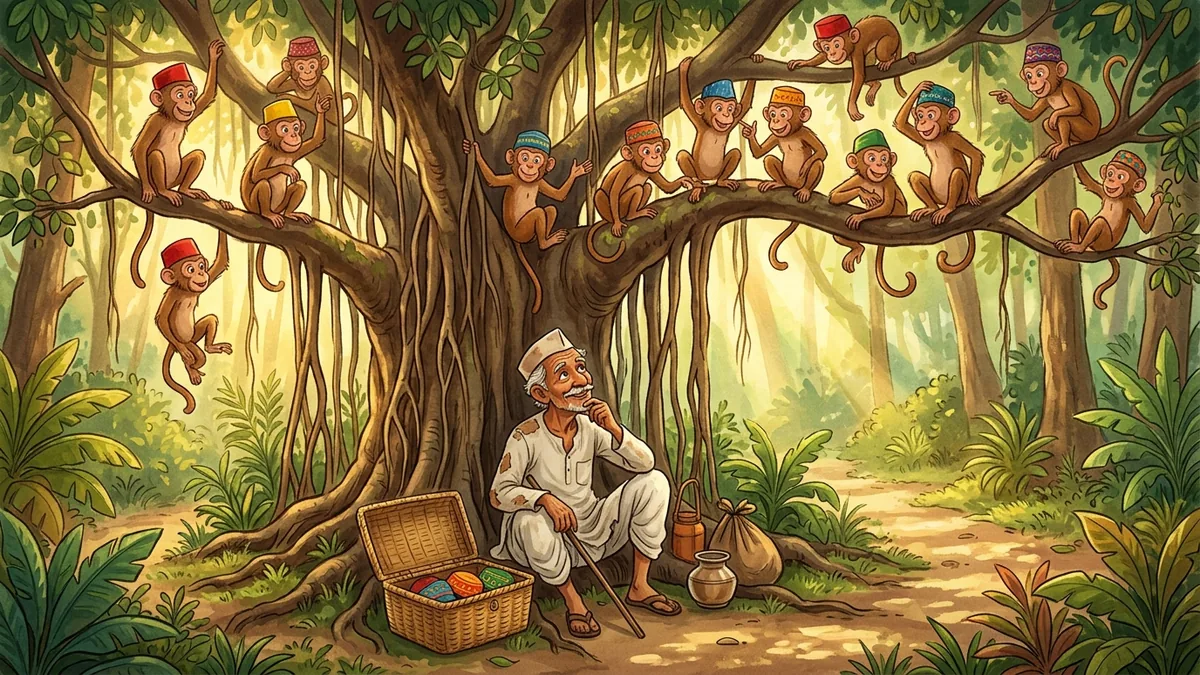
Ramu, a hardworking vendor of vibrant cloth caps, journeyed from village to village earning an honest living. Exhausted by miles of walking under a merciless summer sun, he stopped to rest beneath the sprawling canopy of an ancient banyan tree. Placing his heavy wicker hamper of caps securely beside him, he fell into deep, tranquil slumber. High amidst the branches dwelled a troop of inquisitive, mischievous monkeys. Descending silently, the primates unlatched the hamper, donned the colorful red, green, and yellow caps upon their heads, and scrambled back into the foliage. Upon waking, Ramu was horrified to find his entire inventory vanished, only to look up and see a canopy full of capped monkeys chattering mockingly. He pleaded, shook his fists, and hurled gravel; the monkeys merely mimicked him, pelting him with unripe figs. Realizing that brute anger was futile and remembering that monkeys possess an irresistible instinct for imitation, Ramu devised an ingenious ploy. Removing his own cap, he threw it onto the earth with theatrical fury. Without a moment's hesitation, every monkey ripped off its cap and flung it to the ground. Scooping up his scattered goods, the relieved merchant went on his way. The story teaches that composure, observation of psychology, and wit triumph over despair during acute crises.

The Fox and the Stork

The Fox and the Stork

On the sun-dappled edge of an ancient forest lived Lomasha, a sly, arrogant fox who delighted in playing malicious practical jokes on his woodland neighbors. To humiliate a gentle, dignified stork named Dirghachanchu, the fox invited him to an evening dinner at his den under the guise of hospitality. The stork graciously accepted. When mealtime arrived, the fox maliciously served a thin, savory vegetable broth in two shallow, flat ceramic platters. With his broad tongue, the fox lapped up his portion in seconds, while the poor stork, possessing a long, slender beak, could only peck uselessly against the porcelain, unable to ingest a solitary drop. Pretending innocence, the fox mocked his guest's appetite. The stork masked his hunger and maintained absolute composure. A week later, the stork returned the invitation, welcoming the ravenous fox to his riverside retreat. The stork served an aromatic, delicious stew inside tall, narrow-necked ceramic amphorae with slender spouts. The stork dipped his long beak into the flagon with effortless grace, relishing the meal. But the fox’s broad muzzle could not penetrate the slender neck; he was reduced to licking the exterior glaze in starved humiliation. Turning to the fox with dignified irony, the stork remarked: 'I trust the meal satisfies your palate, brother, for I have merely mirrored the hospitality you bestowed upon me.' Shamed and hungry, the fox slunk away with his tail between his legs. The timeless fable proves that what goes around comes around: treat others with the dignity and empathy you desire for yourself, for those who mock the vulnerable invariably reap the bitter harvest of their own cruelty.

Ten Minutes Every Day

Ten Minutes Every Day

Rohit, an impulsive ninth-grader, lived by the chaotic habit of academic procrastination, relying on exhausting all-night cramming sessions before exams to barely scrape through. This vicious cycle left him chronically stressed, anxious, and plagued by migraines while his artistic and scholastic potentials decayed. Observing his grandson's downward spiral, his retired mathematician grandfather introduced him to the profound philosophy of Kaizen and disciplined Abhyasa: 'Commit exactly ten uninterrupted, sacred minutes every single day to one craft or subject, without permitting a single break in the chain.' Skeptical yet desperate, Rohit pledged ten daily minutes to advanced calculus problems and ten minutes to his neglected bamboo flute. His peers ridiculed the tiny timeframe, laughing that ten minutes was a meaningless drop in the ocean. However, over six months of unbroken daily devotion, the law of compounding generated miraculous transformations. His neural pathways crystallized mathematical proofs into second nature, while his fingers mastered the breathwork of classical ragas with effortless grace. When the state talent Olympiad arrived, the exhausted crammers collapsed under panic, whereas Rohit sailed through with serene mastery, securing a perfect centum in mathematics and the gold medal in classical woodwinds. The story demonstrates that sporadic, exhausting bursts of effort are powerless against the quiet, unyielding compound interest of daily disciplined consistency.

The Science Project That Failed

The Science Project That Failed

At the Grand Finale of the National Children’s Science Congress, fifteen-year-old Kavya presented a revolutionary solar-powered multi-stage water distillation prototype engineered to provide sterile drinking water to fluoride-affected villages. Following months of grueling empirical trials, she commenced her final live demonstration before a panel of eminent aerospace and chemical scientists. Suddenly, an unforeseen micro-fracture and a jammed pressure relief valve triggered a thermal shock explosion; the main borosilicate condenser shattered with a loud crack, spraying scalding muddy brine across her presentation charts and the judges' table. While most students would have collapsed in hysterical tears or abandoned the podium in shame, Kavya demonstrated extraordinary poise and stoic grace. Refusing to succumb to panic, she donned safety gloves, calmly cleared the shattered glass, and opened her meticulous laboratory logbook. Facing the distinguished panel, she delivered an unflinching, masterly post-mortem failure analysis—pinpointing the precise thermodynamic threshold where the material fatigued and presenting a calculated redesign utilizing titanium check-valves. Spellbound by her exceptional scientific temperament, emotional resilience, and refusal to fabricate excuses, the jury awarded her the prestigious 'Scientific Integrity and Resilience Trophy' along with a national research fellowship. The story proves that failure is not the defeat of science, but the very engine of discovery; true greatness lies not in unblemished luck, but in dissecting disaster with courage and wisdom.

The Question Mark Club

The Question Mark Club

In an oppressive and hyper-competitive coaching institute in Kota, the tyrannical physics instructor Mr. Shastri enforced a reign of mechanical rote-memorization: students were strictly forbidden from asking 'Why?' or 'How?', commanded only to memorize formulas and regurgitate derivations for entrance exams. Suffocated by this soulless academic factory, two intellectually rebellious students, Aarav and Meera, founded a clandestine weekend study circle named 'The Question Mark Club.' Gathering in dorm rooms, they dismantled physical laws to first principles, challenging dogma and conducting hands-on empirical tests. When Mr. Shastri uncovered their underground collective, he denounced them as mutinous troublemakers and threatened immediate expulsion. However, fate intervened when a renowned astrophysics professor from the Indian Institute of Science visited the campus for a keynote symposium. The visiting professor scrawled an intractable quantum-optics paradox upon the blackboard that completely derailed Mr. Shastri's standard rote algorithms, leaving the senior faculty humiliated in silence. Rising calmly, Aarav and Meera applied first-principles reasoning honed in their club to resolve the paradox with breathtaking elegance. The visiting luminary embraced them, rebuking the faculty: 'To stifle inquiry is intellectual murder; the question mark is the holy lamp of all progress!' Humbled to the dust, Mr. Shastri acknowledged his tragic dogma and officially institutionalized the Question Mark Club across the curriculum. The story demonstrates that blind memorization breeds intellectual slavery, while fearless, respectful questioning is the mother of all true knowledge.

The Plan B That Saved the Day

The Plan B That Saved the Day

For the Golden Jubilee celebrations of the historic Pinewood Academy in Darjeeling, student council president Kabir was appointed convener of the grand cultural evening. His flamboyant peers insisted on staging the lavish multi-million-rupee musical exclusively inside the open-air mountain amphitheater, dismissing any talk of contingency. Understanding the treacherous unpredictability of Himalayan autumn depressions, Kabir warned that a sudden cloudburst could destroy the celebration, arguing passionately for a robust indoor 'Plan B' inside the multipurpose gymnasium. His peers ridiculed his caution, branding him a pessimistic wet blanket who sabotaged grand visions. Undeterred by their insults, Kabir worked quietly through the nights: he cleaned the indoor sports complex, secured waterproof tarpaulins, laid redundant electrical trunking, and mapped out emergency indoor seating. Two hours before curtain rise, catastrophe struck: an unprecedented cyclonic thunderstorm erupted over the ridge. Hurricane-force winds ripped the outdoor canopy to ribbons, drenching delicate lighting rigs and turning the amphitheater into a muddy lake. With three thousand distinguished global alumni stranded in chaos, the principal prepared to announce a humiliating cancellation. Stepping forward with absolute composure, Kabir mobilized his Plan B. Within forty-five minutes, his pre-briefed crew transitioned the entire festival into the illuminated, warm gymnasium. The concert proved to be the most intimate and legendary triumph in school annals. The story demonstrates that true leadership lies in prudent foresight and patient preparation; the wise soul does not rely on fair weather, but builds an unshakeable shelter before the storm arrives.

The Diary of Small Promises

The Diary of Small Promises

Sahil, an outgoing and charming ninth-grader, had developed a chronic and socially corrosive habit of tossing out casual promises: 'I’ll definitely return your book tomorrow!', 'I’ll help you paint your science chart on Sunday!', 'I’ll call you at five sharp!' Yet he treated these verbal commitments as trivial trifles, perpetually forgetting or breaking them with a flippant shrug: 'It was just a small thing, why are you making a fuss?' Consequently, his classmates, sister, and parents stopped trusting a single word he uttered. Observing his moral decay, his wise grandmother gifted him an antique leather-bound journal titled 'The Diary of Small Promises.' She issued a life-altering spiritual challenge: 'Sahil, record every single promise you utter each day, no matter how tiny. When fulfilled, mark it with a green checkmark; when broken or delayed, stamp it with a bold crimson 'X'.' Accepting the game casually, Sahil opened the ledger at the end of the first week and was horrified to his core: the parchment bled with twenty-four scarlet crosses! Confronted by the undeniable mathematical reality of his own deceit, his conscience shattered. Vowing absolute redemption, Sahil ceased making flippant commitments. Every promise inked into the journal became an inviolable sacred oath. When a catastrophic monsoon cloudburst flooded the city streets during his little sister’s birthday, Sahil abandoned his submerged bicycle and waded two miles through waist-deep waters to deliver the specialized art parchment he had promised her. Inscribing the emerald checkmark that night, he reclaimed his soul. The story demonstrates that character is not forged in grandiose theatrical declarations, but in the sacred fidelity with which we guard our smallest daily promises; a person whose word is unshakeable commands the reverence of the universe.

The Girl Who Learned to Manage Time

The Girl Who Learned to Manage Time

Ananya, an extraordinarily gifted and ambitious tenth-grader, was trapped in a destructive whirlwind of toxic multi-tasking. She was the president of the school robotics society, captain of the debate team, an advanced student of classical Kathak dance, and determined to secure the state rank in the upcoming board examinations. Lacking disciplined time-management and priority discernment, her life spiraled into a chaotic nightmare: surviving on midnight caffeine, skipping meals, perpetually procrastinating until deadlines detonated, and suffering from debilitating migraines and chronic anxiety. Observing her daughter on the precipice of clinical burnout, her mother—a veteran trauma surgeon at the civil hospital—brought Ananya into the hospital emergency command center to demonstrate the profound 'Eisenhower Matrix and the Big Rocks Principle': 'Ananya! If you fill your jar with trivial sand and pebbles first, the monumental foundation stones will never fit; you must allocate sacred space for health, sleep, and core scholastic duties first, ruthlessly discarding the superficial noise.' The revelation transformed Ananya’s psychological architecture. She learned the superpower of uttering a firm 'No' to non-essential commitments, eliminated mindless social media scrolling, implemented disciplined time-blocking, and established eight hours of restorative sleep as an inviolable sanctuary. Within a month, chaotic frenzy gave way to serene, crystalline efficiency. Ananya clinched the state board academic rank while delivering an award-winning Kathak performance. The story demonstrates that time cannot be expanded; only our desires and priorities can be disciplined; master the art of prioritizing the essential, and harmony will crown your life.

The AI Answer That Was Wrong

The AI Answer That Was Wrong

For the prestigious State Science Symposium, twelfth-grader Vivaan undertook an ambitious botanical research paper exploring the medicinal pharmacology of rare endemic flora within the Western Ghats. Seduced by the illusion of effortless speed, Vivaan bypassed traditional peer-reviewed botanical treatises, laboratory assays, and field validations, outsourcing his intellectual labor entirely to an advanced Generative AI neural model. Blindly trusting the synthetic output, he copy-pasted complex chemical pathways, taxonomic classifications, and pharmacological applications directly into his thesis without verifying a single citation. During his keynote presentation, Vivaan theatrically championed a revolutionary herbal decoction extracted from an alleged miracle shrub that the AI claimed permanently eradicated inflammatory rheumatoid arthritis. A classmate’s grandfather, crippled by agonizing joint pain, placed tragic faith in Vivaan’s credentials, foraging the wild shrub matching the AI's fabricated botanical description and brewing a concentrated tea. In terrifying reality, the plant was an AI hallucination—a toxic, neuro-paralytic datura variant that induced violent convulsions and cardiac arrest, plunging the elder into a critical ICU coma! Summoned to the emergency toxicology ward, Vivaan confronted the catastrophic reality of his intellectual arrogance. Dissecting the algorithmic generation logs, he discovered that the AI had manufactured the entire chemical pathway out of statistical probability. Vivaan swiftly produced the physical botanical specimen, enabling physicians to administer the targeted physostigmine antidote to save the patriarch’s life. Withdrawing his thesis in tearful public disgrace, Vivaan addressed the national academy: 'AI can mimic speech, but it possesses neither a soul nor moral accountability; to surrender human discernment to algorithms is suicidal folly.' The story demonstrates that blind delegation of human critical thinking to artificial intelligence is lethal; no algorithm can substitute for rigorous human verification and ethical conscience.

One Hour Without Phones

One Hour Without Phones

The affluent residence of the Sharma family appeared idyllic from the outside, yet inside, it felt like an emotionally sterile digital morgue. All four family members—the tech-executive father Alok, corporate manager mother Vandana, seventeen-year-old son Aditya, and fourteen-year-old daughter Shruti—were hopelessly addicted to the intoxicating glow of their respective smartphone screens. Whether at the dinner table, morning tea, or weekend living rooms, their heads remained bowed in catatonic silence, their thumbs incessantly scrolling through short-form video feeds and social notifications. They lived as four isolated phantoms sharing a roof without exchanging a single soulful word. When their eighty-year-old grandfather, Pandit Deenanath, arrived from the ancestral village for an extended visit, he was appalled by the living spiritual death around him. Summoning the family, the patriarch instituted an unyielding decree: 'Every evening at sunset, from seven to eight sharp, all digital devices shall be locked inside a wooden chest; this 'Golden Hour Without Screens' shall be dedicated exclusively to eye-to-eye human presence!' Initially, severe digital withdrawal triggered restlessness, irritability, and awkward silence. Yet by the third evening, the miracle of authentic human communion unfolded: devoid of synthetic distractions, conversation erupted; the father retrieved his neglected acoustic guitar, the mother shared poignant poetry from her youth, the grandfather narrated heroic sagas of ancestral sacrifice, and the children wept openly, confiding academic anxieties and loneliness long suppressed beneath screen addictions. That solitary unplugged hour breathed life back into their dying relationships, filling the home with genuine laughter, psychological peace, and unbreakable intimacy. The story demonstrates that smartphones connect us to an illusionary distant world while alienating us from the living souls sitting right beside us; disconnecting from virtual noise is the only path to reclaiming real human love and emotional harmony.


The Pocket-Money Plan

The Pocket-Money Plan

Fourteen-year-old Tanya, the pampered only child of corporate executives, received a lavish monthly pocket allowance of three thousand rupees. Yet she possessed zero financial discernment: within the first ninety-six hours of each month, her entire allowance vanished into delivered fast food, fast-fashion accessories, and frivolous mobile game microtransactions, leaving her penniless, anxious, and petulantly demanding advances for the remaining twenty-six days. Observing her granddaughter drifting into chronic consumerist entitlement, her wise maternal grandmother—who had weathered severe post-independence austerity through disciplined budgeting—intervened. Gifting Tanya an antique, hand-carved deodar wooden chest featuring three locked brass compartments, she introduced the legendary '50-30-20 Rule of Conscious Stewardship': 'Needs' (50%), 'Future Dreams' (30%), and 'Sacred Giving' (20%). The grandmother imparted a life-altering axiom: 'Tanya, money is an exceptional servant, but if you do not master its discipline, it will become the most tyrannical master of your soul!' Committing to the covenant, Tanya recorded every expenditure in a ledger, learning the superpower of resisting impulse dopamine purchases. Over six months, the compounding mathematics produced miracles: her 'Dream' compartment accumulated sufficient capital to purchase a high-powered astronomical telescope she had coveted for years; concurrently, her 'Giving' vault funded the annual tuition, braille literature, and uniform for the blind daughter of her building's night watchman. When the child wrapped her arms around Tanya in tearful gratitude, Tanya experienced a transcendent joy that commercial luxuries could never purchase. The story demonstrates that financial independence is not dictated by how much wealth flows into your hands, but by the conscious discipline with which you allocate your resources; disciplined budgeting and compassionate sharing elevate wealth from a selfish vice into a vehicle of human virtue.