Environment
🎯 Topic Pillar Hub 📚 13 Illustrated Stories

Environment

Earth gives selflessly to sustain us. Protecting our forests, rivers, and wildlife is our sacred civic and moral responsibility.

✕ Clear
All Stories Friendship Discipline & Duty Courage Honesty Kindness Patience & Humility Digital Ethics Environment Civic Duty & Safety Wisdom Fairness & Inclusion Compassion
The Drum That Belonged to Everyone

The Drum That Belonged to Everyone

A drum used at community celebrations is damaged after everyone assumes someone else will store it. The neighbours create a shared care rota and small repair fund so access comes with responsibility.

The Fisher’s Small Catch

The Fisher’s Small Catch

A fisher has a smaller catch than expected but leaves young fish in a breeding area. The fisher and neighbours agree on fair, voluntary practices that protect both today’s livelihoods and tomorrow’s supply.

The Picnic with a Plan

The Picnic with a Plan

A class plans a picnic with reusable containers, realistic portions, water refill points, and a plan to take all waste back.

The Shared Tool Shed

The Shared Tool Shed

A neighbourhood creates a tool shed for occasional-use equipment. Clear borrowing records, safety checks, and repairs keep the resource available to everyone.

The Seed Library

The Seed Library

A school starts a seed library where families save and exchange suitable local seeds and record what grows well.

The Tap That Ran All Night

The Tap That Ran All Night

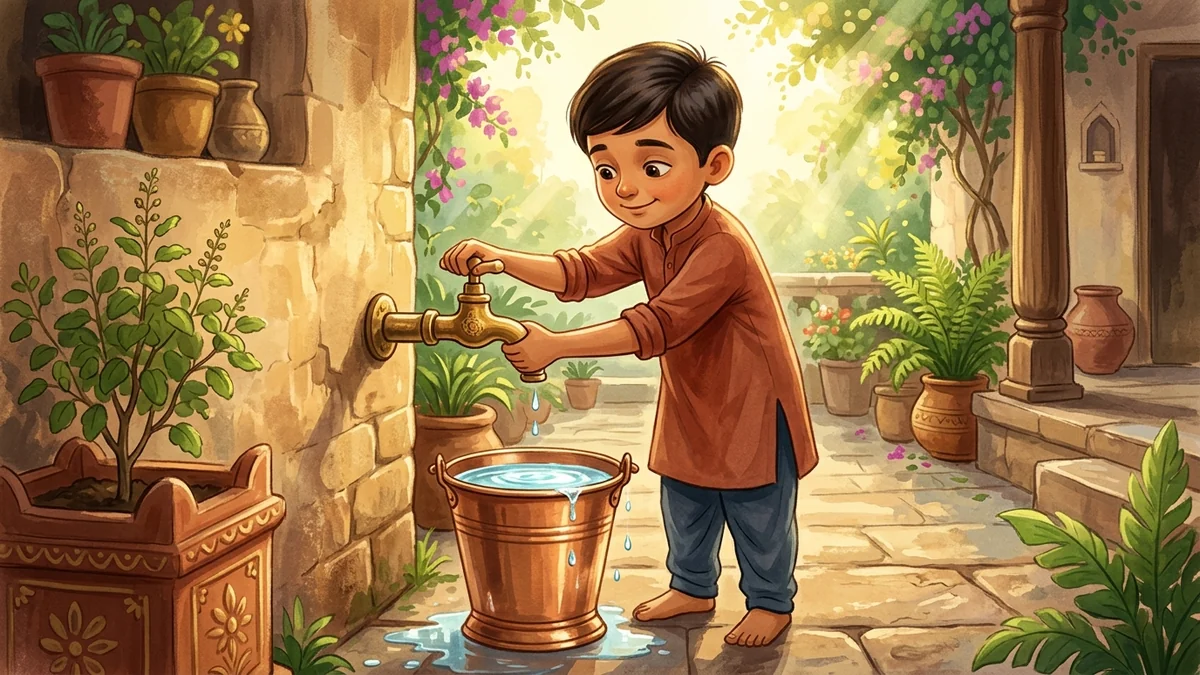
Fifteen-year-old Rohit, residing in a luxurious metropolitan penthouse where high-pressure municipal water flowed uninterrupted, took the sacred resource entirely for granted. One evening, after hosing down the terrace garden, he rushed inside to join an online gaming marathon, leaving the high-capacity brass tap fully open all night. Thousands of liters of pure, treated drinking water flooded the paved courtyard and gushed into open stormwater drains. When his father confronted him at dawn over the catastrophic waste, Rohit shrugged with calloused adolescent entitlement: 'Dad, it was just water! We pay the utility bills on time, why are you making such a dramatic scene?' Shattered by his son's arrogant blindness, the father packed their bags that very weekend and drove Rohit without explanation into the scorched, drought-ravaged heartland of Bundelkhand. There, under a blistering 47°C sun, Rohit beheld barefoot mothers and eight-year-old girls trudging four miles across blistering gravel to dredge muddy, contaminated sludge from an evaporating crater, weeping over half a bucket of water. An impoverished farmer collapsed before them, his livestock dying of thirst. The harrowing reality cleaved Rohit’s soul in two: the precious liquid he had carelessly drowned into the sewer overnight could have sustained that entire village for a week! Weeping in gut-wrenching repentance, Rohit surrendered his summer vacation to dig rainwater percolation trenches with the villagers. Returning home, he installed aerators across his residential enclave, leading a youth crusade for water stewardship. The story demonstrates that water is not a commercial commodity purchased with money, but the sacred bloodline of planetary life; squandering water in privilege is a moral crime against those who weep for a single drop.

The Sapling on the Empty Plot

The Sapling on the Empty Plot

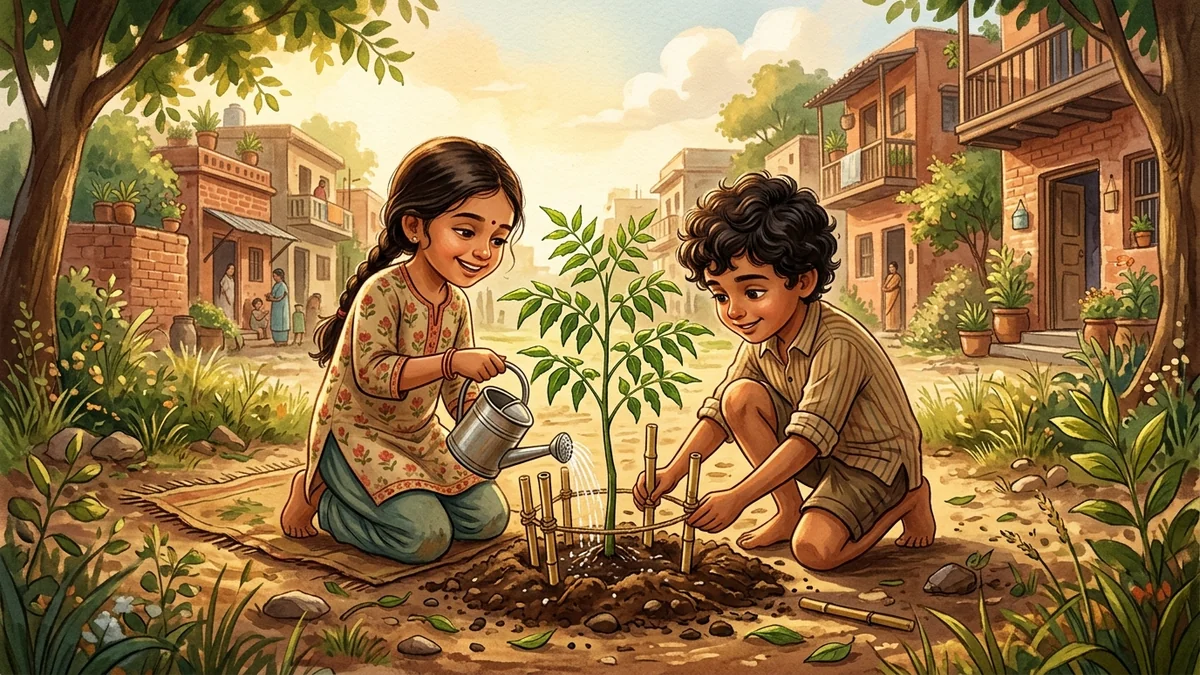
In a rapidly urbanizing, dust-choked satellite city bordering Delhi, an abandoned vacant plot had degenerated over years into a toxic municipal wasteland—choked with construction rubble, decaying garbage, plastic debris, and stagnant mosquito-infested sludge. While the surrounding residents endlessly cursed the municipal corporation from behind closed air-conditioned windows, zero citizens lifted a finger to remedy the rot. Eleven-year-old Meera, walking to school one morning, spotted a fragile, solitary Neem sapling miraculously sprouting through a hairline crack in a discarded slab of toxic concrete. Moved by the indefatigable will of the fragile green life, Meera vowed to preserve it. When she began clearing the broken glass and sharp rubble with her bare hands, cynical neighbors sneered from their balconies: 'Look at the foolish child playing municipal sweeper! That weed will wither in forty-eight hours in this poison!' Undeterred by ridicule, Meera persevered with monastic devotion: weaving a protective bamboo palisade to shield it from feral dogs, hauling heavy buckets of water twice daily, and engineering an ingenious gravity drip-irrigation device from discarded beverage bottles during a 46°C heatwave. Witnessing a fragile child's unyielding devotion to life, a retired military colonel, local mothers, and youth were seized by profound collective conscience. What began as a solitary girl shielding a fragile shoot metastasized into a neighborhood ecological revolution: clearing thirty tons of industrial rubble, planting one hundred and fifty indigenous shade trees, and transforming the toxic blight into a lush, birdsong-filled community sanctuary. Years later, sitting beneath the whispering canopy of the towering Neem, the township honored Meera as their 'Guardian of the Earth.' The story demonstrates that cursing the darkness of ecological ruin achieves nothing; a single soul cultivating life with sacred perseverance possesses the power to resurrect a forest from the ashes of desolation.

The Clean Lane Challenge

The Clean Lane Challenge

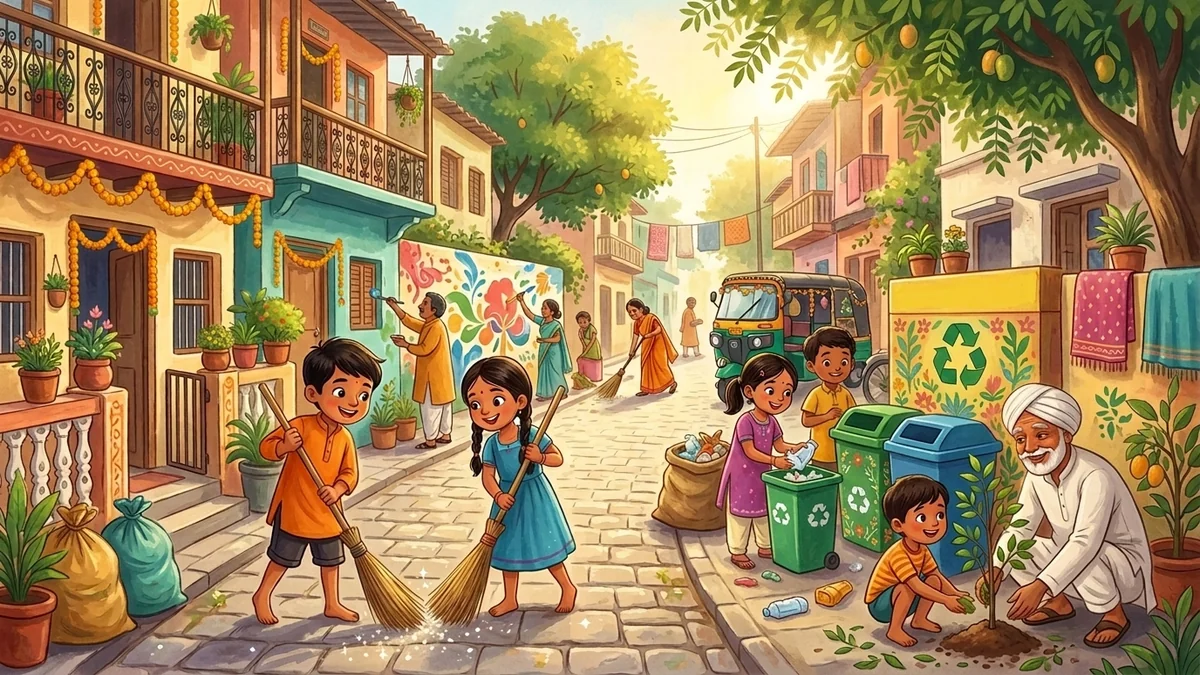
In an ancient, cobblestone residential alley of Varanasi known as 'Gopal Gali,' the civic reality was an unmitigated environmental nightmare. Open stone drainage conduits overflowed with single-use plastics, historic lime-plastered walls were defaced by foul scarlet betel-spit stains, and mounds of decomposing domestic refuse festered before every doorway. Every evening, residents congregated upon stone verandas bitterly cursing the municipal corporation and sanitation sweepers; yet every sunrise, those very households hurled plastic garbage bags directly from their second-floor balconies into the street below. Eleventh-grader Deepa, studying environmental science, resolved to shatter this hypocritical paralysis. Refusing to indulge in idle rhetoric or self-righteous slogans, Deepa invested her personal savings to purchase industrial rubber gloves, a stiff coir broom, and heavy-duty biodegradable bins. At five o’clock the following dawn, while the neighborhood slept, Deepa descended into the filthy lane solitary and unannounced, sweeping away the decaying sludge with rhythmic grace. Cynical neighbors sneered from their verandas: 'Look at the schoolmaster’s daughter playing municipal scavenger!' Deepa absorbed the mockery in absolute, serene silence. By day four, overcome with profound psychological guilt, an elderly retired teacher and the corner grocer picked up brooms and joined her. The solitary spark detonated an unstoppable civic wildfire: within a fortnight, every youth and household rallied into action—installing drainage filters, painting ancient walls with vibrant Madhubani folk murals, and instituting strict zero-litter neighborhood compacts. Within a month, the once-notorious slum lane was officially designated the 'Model Clean Heritage Lane of the State.' The story illustrates that civic transformation is never achieved through comfortable armchair complaints; pick up the broom yourself, for humble, courageous action awakens the sleeping conscience of humanity far louder than a thousand hollow speeches.

The Festival Without Waste

The Festival Without Waste

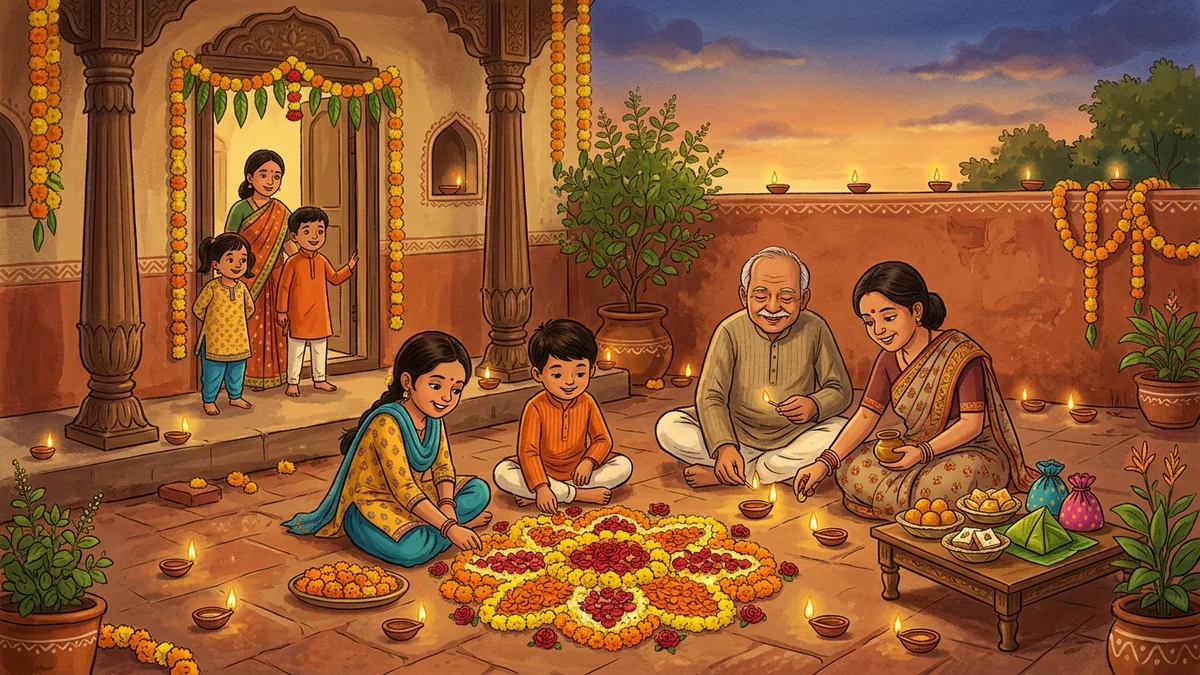
In an opulent high-rise residential cooperative in Pune, the annual Ganesh Utsav was celebrated with ostentatious spectacle. Yet each autumn, once the revelry subsided, the society premises and the adjoining sacred Mutha River were left choked beneath mountains of toxic non-biodegradable Plaster of Paris (PoP) idols, styrofoam cutouts, and single-use plastic banquet waste, poisoning the aquatic ecosystem and killing thousands of fish. Twelfth-grader Aniruddh, an ardent naturalist, was horrified by this seasonal desecration masquerading as piety. He posed a searing philosophical inquiry to his conscience: 'Can Lord Ganesha, the primordial deity of nature and cosmic harmony, truly be pleased by the toxic murder of Mother Earth?' Aniruddh drafted an ambitious blueprint for a 'Zero-Waste Eco-Festival': replacing chemical PoP with indigenous river clay embedded with marigold and holy basil seeds; mandating biodegradable areca palm leaf plates (patravali); and converting truckloads of floral offerings into microbial organic compost. Conservative committee elders initially ridiculed his vision as 'austere, troublesome, and disruptive.' Undeterred, Aniruddh sculpted a seed-clay prototype with his own hands, proving that sacred traditions and ecological stewardship were harmonious. Conceding to his passionate plea, the community executed the green blueprint. The immersion ceremony took place within an artificial rainwater tank; the dissolved holy silt was transferred to the residential arboretum, where three months later, hundreds of fragrant golden blossoms emerged. The municipality awarded the enclave the Chief Minister’s 'Green Heritage Trophy.' The story proves that authentic spirituality honors the Divine by fiercely protecting creation; a festival is holy only when it leaves behind blooming life rather than a toxic desert of waste.

The Broken Bench in the Park

The Broken Bench in the Park

Inside the historic Freedom Fighters Memorial Park, the municipality had installed solid teakwood and cast-iron heritage benches beneath shaded banyan trees for the convalescence of senior citizens and mothers. A reckless quartet of eleventh-graders—Mayank, Vicky, Harsh, and Rohan—routinely lounged in the park, treating the public installations with aggressive adolescent vandalization: stomping across the wooden slats with muddy soccer cleats, prying open retaining bolts with screwdrivers, and slamming heavy boulders against the frames to showcase their athletic bravado. When Mayank voiced hesitant misgivings, Vicky sneered with cynical flippancy: 'Relax, coward! It’s government property—it belongs to nobody! If it snaps, the municipality will dump tax money for a new one; why are you losing sleep?' Compromised by their sabotage, the central deodar bench suffered deep structural fractures. The following dawn, eighty-two-year-old retired schoolmaster Pandit Deenanath—a fragile cardiac patient who walked daily with a cane—sank gratefully onto the bench to catch his breath. The fractured timbers gave way with a violent crack; the heavy iron arm collapsed, casting the frail elder headfirst onto the jagged stone curb! His femoral hip fractured, and blood pooled upon the gravel. Passing by the gates, Mayank witnessed the sirens wailing and the screaming elder being wheeled into the trauma ambulance. A searing bolt of moral agony cleaved his soul: 'Public property is not 'nobody's' property; it is the sacred shared sanctuary of our own grandmothers and children! Our vandalism nearly murdered an innocent elder!' Refusing to run, Mayank confessed the crime to his father, confronting his three accomplices with relentless moral fury. Pooling their collective savings, the boys purchased seasoned teak planks, industrial fasteners, and rust-proof enamel. Laboring through the week, they restored and reinforced every bench across the park, stenciling an indelible message: 'Public Property is Our Collective Home: Guard It with Your Life.' When Pandit Deenanath returned on crutches, he embraced the tearful boys in forgiveness. The story demonstrates that public property is not state-owned debris, but the shared sanctuary of a civilized society; defacing public assets is a treason against our own community.

The Toy That Was Repaired

The Toy That Was Repaired

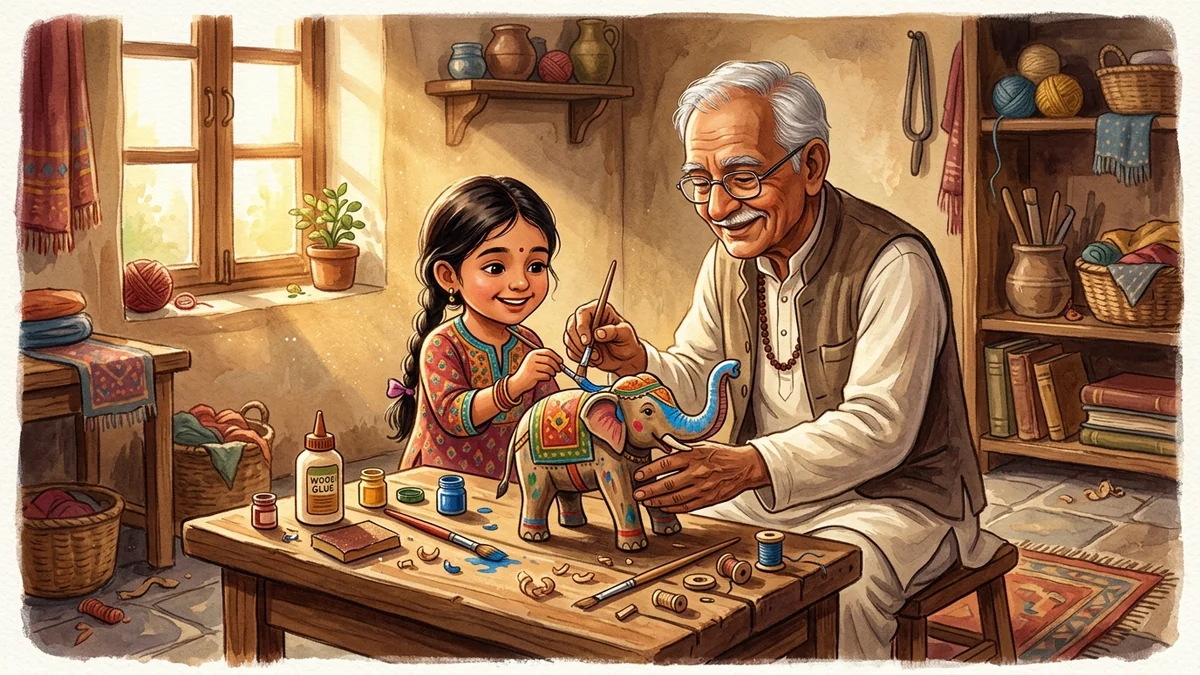
Ten-year-old Kabir, nurtured within the disposable, hyper-consumerist culture of the modern metropolis, possessed zero reverence for material possessions or human effort. Surrounded by mountains of electronic gadgets, plastic toys, and designer apparel, his reflexive habit upon encountering the slightest defect was to discard the item into the trash and petulantly demand an immediate replacement. On his birthday, his prized high-speed remote-controlled monster truck collided with a hardwood cabinet, fracturing the primary wheel axle and dislodging the internal drive gears. True to his spoiled instincts, Kabir hurled the expensive machine into the waste bin with a violent kick, screaming for an imported successor. His grandfather, an eighty-year-old retired Chief Mechanical Engineer of the Indian Railways, retrieved the broken artifact from the garbage. Guiding Kabir into his sunlit garage workshop, the patriarch imparted an immortal philosophy: 'Kabir, in our generation, when an instrument fractured, we did not throw it away into the dustbin; we sat together with patience and repaired it—whether it was a machine, a tool, or a human relationship!' Over three dedicated evenings, the grandfather and grandson dismantled the chassis, machined a new brass axle upon a miniature lathe, lubricated the nylon gears, and resoldered the motor connections. When the vehicle was deployed across the rug, it operated with far greater speed, durability, and mechanical elegance than its factory form! Experiencing the transcendent joy of patient craftsmanship, Kabir underwent a profound spiritual rebirth. When his mother’s vintage brass reading lamp failed a week later, instead of discarding it, Kabir dismantled the socket, repaired the wiring, and restored its light. The story demonstrates that a disposable mindset destroys both planetary ecology and human relationships; the noble art of patient repair fosters mindfulness, creative mastery, and the enduring resilience of the human soul.


The Ancient Banyan and the Tiny Sparrow

The Ancient Banyan and the Tiny Sparrow

In the heart of the Vindhya mountains stood an ancient banyan whose majestic boughs had sheltered generations of creatures through storms and droughts. When a ferocious wildfire encircled the forest, mighty beasts and feathered flocks fled in terror, abandoning the sacred tree. But a tiny sparrow named Chanchala flew relentlessly between the river and the inferno, dropping minuscule beads of water from her beak upon the flames. When the divine Garuda questioned her futile toil, she declared: 'When history judges this day, my name shall stand not among those who caused the fire or fled in cowardice, but among those who fought to extinguish it.' The parable immortalizes the truth that devotion and duty outweigh the scale of one's resources.